A WW5 Aviator round is a race between a rising multiplier and a crash point. You place a stake, the curve on screen climbs, and you have to cash out before it comes down, because once it crashes the round is over and the stake is lost. The length of every round is random, so there is no way to read the crash point off the curve in advance, and the only real decision in the game is the moment you press cash out. If you are new to the platform, the directory of all seven WW5 games is the fastest way to see how this title compares with the rest.
Aviator rewards one thing above everything else, which is control of the moment you exit. That makes it worth reading next to Dragon Tiger, where you commit to a side before a card is turned, and next to Teen Patti, where the reading of a hand decides the pot. This guide covers how a round runs, why the curve carries no information, how to set a cash-out plan you can keep to, and where Andar Bahar sits if you would rather play a game with fewer moving parts.
How a round runs, start to finish
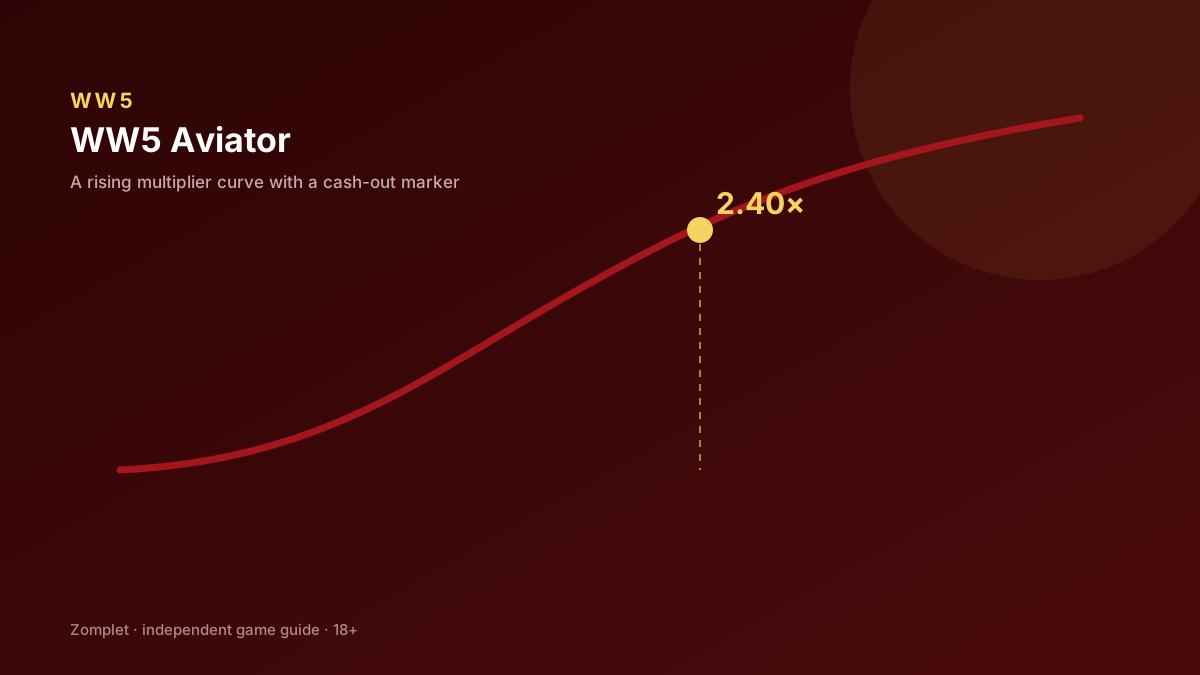
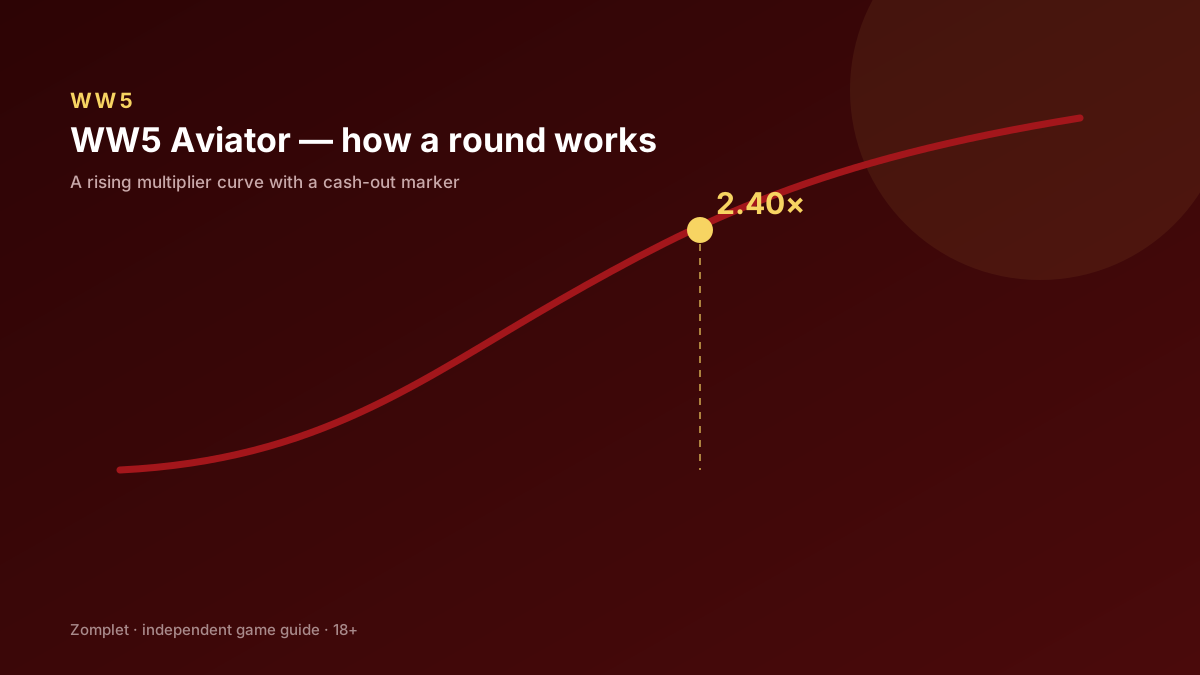
Everything happens in one short cycle. You pick a stake, the betting window closes, and the curve starts low and rises on a timer while a number counts up beside it. At some unpredictable point the curve stops, and that stopping point is the crash. Cash out before it and your stake is paid at the multiplier you reached; wait past it and the round takes the stake with it.
- Choose your stake. Pick an amount you could lose outright without it changing your evening, because that is exactly what a bad round does.
- Join before the round starts. The betting window closes when the curve begins, so a late tap is a missed round rather than a bad entry.
- Watch the curve climb. The multiplier counts up and nothing on the screen tells you where the climb will end.
- Cash out at your target. One tap turns the stake into a payout at the current multiplier.
- Decide about another round yourself. The game never asks you to start the next one, and that decision is where the time actually goes.
What the curve does and does not tell you
This is worth being blunt about. The curve is not a signal, and it carries no information about the next round. Each round is generated independently, so the round that just crashed at a low multiplier tells you nothing useful about the one in front of you, and a long climb is not building towards anything.
The curve is an output, not an input
It is easy to read a long climb as a sign that something is loading up behind it. It is not. The curve only exists once a round has started, and it records what has already happened rather than previewing what will happen next. Treating it as a preview is the most common mistake in this game, because a number on a screen feels like information even when it is only a running record.
Two players, one curve, two different results
Several players can be on the same round, watching the same curve climb, and they will not all cash out at the same point. One player may take a small multiple early while another holds on and takes a larger one. Neither player did anything the other could not have done at the same moment, because the only variable in reach was the timing of a tap.
| Moment in the round | Player A | Player B | What decided it |
|---|---|---|---|
| Early in the climb | Cashes out and banks a small multiple | Holds the bet | Only the timing of the tap |
| Midway up the curve | Already out and watching | Still riding the round | Only the timing of the tap |
| Late in the climb | Cannot re-enter the round | Decides to exit | Round length is random |
| After the crash | Keeps the earlier payout | Loses the stake | The crash point was not knowable |
A session plan that survives a bad run
Most losses in Aviator come from a plan that only works while things are going well. Set the plan before the first round and treat it as fixed for the session, because judgement is at its weakest directly after a loss.
- Decide the stake first. A stake small enough that a full run of losses cannot hurt you is worth more than a stake that makes one round feel exciting.
- Pick one exit multiplier and hold it. A fixed target that you do not move around is easier to keep than a judgement call made several times a second.
- Cap the number of rounds. Rounds take seconds, so a cap on rounds is the only thing that reliably ends a session.
- Step away after a run of losses. The next round will be no more predictable than the last one, and the pressure to win it back is the real danger.
- Keep a note of what you did. Exit multipliers, number of rounds and net result are worth more than any system you will read about later.
Money, state rules and the part you cannot control
If you are only using free-play mode, none of this section applies to you. If you intend to put money on it, read this once before your first deposit. Money-based play is restricted or prohibited in Andhra Pradesh, Telangana, Tamil Nadu, Karnataka, Odisha, Assam and Meghalaya. Check your local position before depositing, and never use a VPN or another person's account to work around a restriction.
This guide is written for adults aged 18 and over. Zomplet does not run the game, does not host any download and does not accept payment for a mention. We never link to a modified or repackaged build, and a site that offers one is telling you something it should not have to.
Where Aviator sits in the rest of the library
Aviator is the title on the platform where the skill is closest to timing and furthest from card knowledge. Andar Bahar is the opposite end of the scale, with one card starting the deal and the rest close to a coin flip between two sides, and 7up 7down is another single-decision round with fixed odds. The rules and strategy guide is the place to read about bankroll and session length before you commit to a routine.
Frequently asked questions
How do I play WW5 Aviator?
Pick a stake before the round starts, let the curve climb, and press cash out before it crashes. Cash out in time and you are paid at the multiplier on screen; wait for the crash and the stake is lost. Round length is random every time.
Can I predict when the curve will crash?
No. The curve is generated independently of previous rounds and carries no information about the next one. Nothing in the pattern of earlier rounds shifts the odds of the round in front of you, however convincing the pattern looks.
Is there a strategy that beats Aviator?
There is no strategy that takes the randomness out of a round. What you control is the stake, the exit point and the length of the session, and holding those three steady is what a good session looks like in practice.
Why do two players on the same round get different results?
Because the cash-out decision belongs to each player. One may take a small multiple early while another holds and takes a larger one, or one may lose the stake while the other has already banked a payout. The curve is shared, the decision is not.
How long should an Aviator session be?
Short. Rounds take seconds, so the risk is not one round but the number of rounds you start. Decide a round limit and a stake limit before the first round, and stop when either one is reached.
Is Aviator legal to play for money in India?
It depends on where you are. Money-based play is restricted or prohibited in Andhra Pradesh, Telangana, Tamil Nadu, Karnataka, Odisha, Assam and Meghalaya. Check your local position before depositing, and never use a VPN or another person's account to work around a restriction. Zomplet covers these games for adults aged 18 and over.
Related guides
WW5 Dragon Tiger: how a one-card comparison decides each round
WW5 Dragon Tiger explained: the three bets, how a single card decides the round, why the tie pays differently, and what to check before you play for money.
WW5 Teen Patti: the hand rankings, the formats and the side show
WW5 Teen Patti explained for beginners: the hand order from high card to straight flush, two-player and three-player formats, and what a side show actually does.
WW5 gameplay rules and strategy: separating skill from chance, and setting limits
WW5 gameplay rules and strategy explained: which games reward judgement, which are pure chance, and why bankroll and session limits matter most.