A WW5 Dragon Tiger round is the simplest thing on the platform. Two cards are dealt, one to the Dragon and one to the Tiger, and the higher card takes the side it belongs to. There is no decision to make after that first tap, which makes this the easiest title to understand and the least interesting to spend an hour inside. The whole of the strategy sits in the bet you place before the deal and in how you read the tie. The directory of every WW5 game is worth a look before you settle on one title.
Dragon Tiger is interesting precisely because the differences from the rest of the library are so sharp. Andar Bahar runs on a single card and a prediction, Teen Patti runs on three cards and a hand ranking, and Aviator has no cards at all, only a timing decision. This guide covers the three bets, the tie, and why the count of cards in the deck matters more than most players expect.
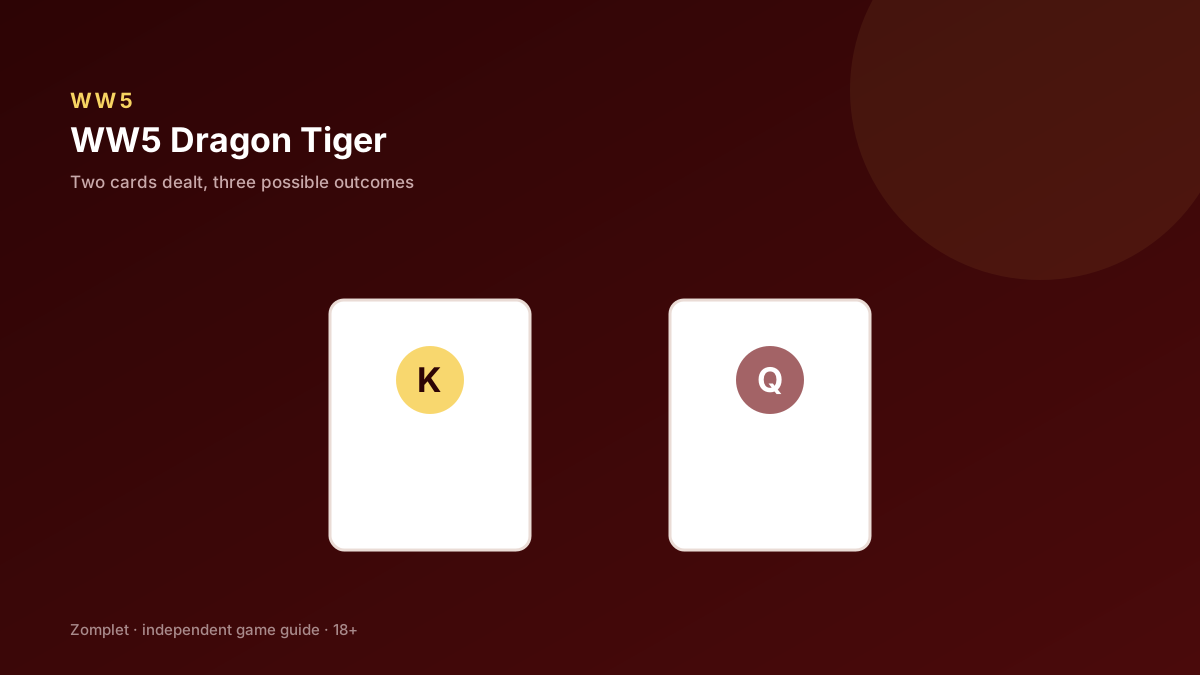
One card each, three possible results
A round takes a few seconds to deal and resolve. The card that lands higher takes the side it belongs to, and when the two cards carry the same rank the round goes to the tie result, which is the one outcome that neither side bet covers.
- Dragon — the card dealt to the Dragon is higher than the Tiger card.
- Tiger — the card dealt to the Tiger is higher than the Dragon card.
- Tie — both cards carry the same rank.
The three bets and what each one needs
| Bet | What it needs to win | How it is paid | How it is decided |
|---|---|---|---|
| Dragon | The Dragon card outranks the Tiger card | Paid at the standard rate for a side bet | One card comparison |
| Tiger | The Tiger card outranks the Dragon card | Paid at the standard rate for a side bet | One card comparison |
| Tie | Both cards carry the same rank | Pays differently from the side bets, because the chance of it is far smaller | One card repeating a rank |
The tie bet is the one that needs a sentence of explanation, because it pays differently from the other two. A tie is rare compared with either side winning, so it carries a bigger return for a much smaller chance. Bigger return, smaller chance, more punishing when it lands. Read the payout table on the screen you are actually playing on rather than assuming a rate you saw somewhere else.
The number of cards in play changes the arithmetic
Dragon Tiger can be dealt from a smaller deck than a full fifty-two card pack, and the number of cards in play changes how the round behaves. With fewer cards in the deck, rank repeats come up more often, which makes the tie more reachable than it first appears. How many cards are actually in the shoe is worth confirming on the table screen before you build any assumption on top of it.
Playing a first session
- Read the table limits first. The minimum and maximum stakes are shown before you bet, and they decide the size of the session you are about to have.
- Pick one side. Dragon and Tiger carry the same odds, so choose the one your hand is on rather than the one that looks busier on the screen.
- Decide about the tie in advance. Adding a tie bet changes the risk of a round, and it is better made calmly than in the moment.
- Watch a few rounds before committing a stake. The dealing is quick, and observing a handful of rounds shows you how the table handles a bet and a settlement.
- Stop when the plan says stop. With rounds this short, a session ends by accident more often than by decision.
What this format rewards, and what it does not
A format with one decision per round rewards a clear head and a fixed stake. It does not reward studying patterns, and there are no patterns here to study. The counted-card reasoning that carries weight in a longer card game does very little in a round that lasts fifteen seconds.
Where the game does reward attention is in the unglamorous places. Knowing what the tie pays on this particular table, knowing how many cards are in the shoe, and knowing where your own stop line sits are worth more than any system for picking a side.
Money, state rules and age
If you plan to play for money rather than in free-play mode, read this before your first deposit. Money-based play is restricted or prohibited in Andhra Pradesh, Telangana, Tamil Nadu, Karnataka, Odisha, Assam and Meghalaya. Check your local position before depositing, and never use a VPN or another person's account to work around a restriction.
This guide is for adults aged 18 and over. Zomplet does not operate the game, does not host a download and takes no payment for a mention. We never link to a modified or repackaged build, and any site offering one is telling you something about itself.
How Dragon Tiger compares with the rest
Dragon Tiger is the shortest possible introduction to a money-based card game, which makes it a reasonable first title and a poor place to look for depth. For something with more layers, Teen Patti adds a hand ranking and a side show, while Andar Bahar uses a single card to set up a prediction instead of a comparison. The home page directory lists all seven titles with the time each session takes.
Frequently asked questions
What is Dragon Tiger and how do you play it?
Two cards are dealt, one for the Dragon and one for the Tiger, and the higher card wins that side. You pick Dragon, Tiger or a tie before the deal, and there is nothing left to decide afterwards. A round takes about fifteen seconds.
What happens on a tie?
When both cards carry the same rank, the round goes to the tie result. Neither side bet wins, and the tie bet pays differently from the side bets because its chance of landing is much smaller.
Is Dragon Tiger just luck?
Almost entirely. There is one decision to make, and it is a choice between two near-identical sides plus a rarer third option. What you actually control is the size of the stake, the length of the session and whether the tie bet belongs in your plan.
Does the number of cards in the deck matter?
It does. A smaller deck makes rank repeats more likely, which changes how often a tie can happen and how the sides compare. Confirm how many cards are in play on the table screen rather than assuming a standard pack.
Is there a pattern to watch for in Dragon Tiger?
No. Rounds are independent of one another, and a run of Dragon or Tiger results does not make the other side more likely. Reading a streak as a signal is the most common way players talk themselves into a bad bet.
Can I play Dragon Tiger for real money in India?
Money-based play is restricted or prohibited in Andhra Pradesh, Telangana, Tamil Nadu, Karnataka, Odisha, Assam and Meghalaya. Check your local position before depositing, and never use a VPN or another person's account to work around a restriction. This guide covers the game for adults aged 18 and over.
Related guides
WW5 Aviator: how a rising multiplier round actually works
How the WW5 Aviator round works, how long a session lasts, what the cash-out decision really involves, and the drawbacks nobody mentions.
WW5 Andar Bahar: how one card sets up the whole round
WW5 Andar Bahar explained: how a single card sets up an alternating deal, why you are close to betting on a coin flip, and why counting cards does not work here.
WW5 gameplay rules and strategy: separating skill from chance, and setting limits
WW5 gameplay rules and strategy explained: which games reward judgement, which are pure chance, and why bankroll and session limits matter most.