The honest position on the WW5 platform is that some of these games are pure chance and a few genuinely reward judgement, and pretending otherwise is the most useful thing an article on the subject can avoid. The title that rewards the most skill is the one where you build a fantasy XI and it is scored against a real match. The titles that reward the least are the ones where a single tap decides everything. This guide sorts the seven titles into that order, explains why the distinction matters, and then covers the part that actually protects your money: bankroll limits and session limits. It is written for adults aged 18 and over.
For the full list of what is on the platform, the Zomplet home page lists all seven WW5 titles with their difficulty and session length. If you want the rules of one specific game rather than the general framework, WW5 Fantasy Cricket and WW5 Slots are the two worth reading together, since they sit at opposite ends of the skill range. The account checks that come before any of this are in account registration and login, and the install route is in the download guide.
Every guide on this site describes a specific game. This one is about the layer underneath all of them: what kind of decision each title asks for, why the honest answer is that most of them are not winnable, and which few habits are worth having regardless of which game you open.
Sorting the seven titles by what they ask of you
The useful question for any title is what decisions it puts in front of you and whether those decisions can be made well. A decision made well is skill. A decision that has no better answer than a guess is chance wearing a decision's clothes. Sorting the catalogue this way is more informative than the difficulty label any app will give you, because difficulty usually measures how long a session runs rather than whether judgement changes anything.
| Title | The decision it asks for | Can judgement improve it? | Where the control actually is |
|---|---|---|---|
| Fantasy Cricket | Build an XI from real players, and set a captain | Yes, substantially, through form, matchup, venue and role | In the selection, which is repeatable |
| Teen Patti | How to play a hand, and when to bluff | Partly, and the read of other players is genuinely hard | In the read of the table, and it is a bluffing game |
| Aviator | When to cash out before the multiplier goes further | Partly, but the round outcome itself is fixed and random | In the timing decision, not the result |
| Dragon Tiger | Which side to back, and whether to bet on a tie | Not for the side, but you can decline to bet on a tie | Only in stake size and session length |
| Andar Bahar | Which side the comparison will land on | No, the two sides are close to even | Only in stake size and session length |
| 7up 7down | Whether the total lands above, below or on seven | No, the six-of-thirty-six split is fixed | Only in stake size and session length |
| Slots | Which title, which lines, and when to stop | Not the outcome, since every spin is independent | Only in stake size, lines and session length |
Where the real skill sits
Even in the games that reward judgement, the skill is narrower than people assume. In Fantasy Cricket it is the selection: recent form, the matchup against this opposition, the venue, and the role a player has. In Teen Patti it is reading a table and deciding whether to bluff. In Aviator it is the timing of a cash-out. In none of them is it predicting the future, which is what most of the talk around these games quietly assumes.
What a decision has to look like to be real
A decision is a real one when a better-informed person would reliably choose differently from a less-informed one, and when the outcome of choosing well shows up afterwards. Fantasy Cricket passes this test: someone who has followed a player's recent form and knows who is bowling will build a different XI from someone picking by reputation, and the points will reflect it. A dice side bet does not, because there is no information about the next roll available to anyone.
Why the short titles stay short
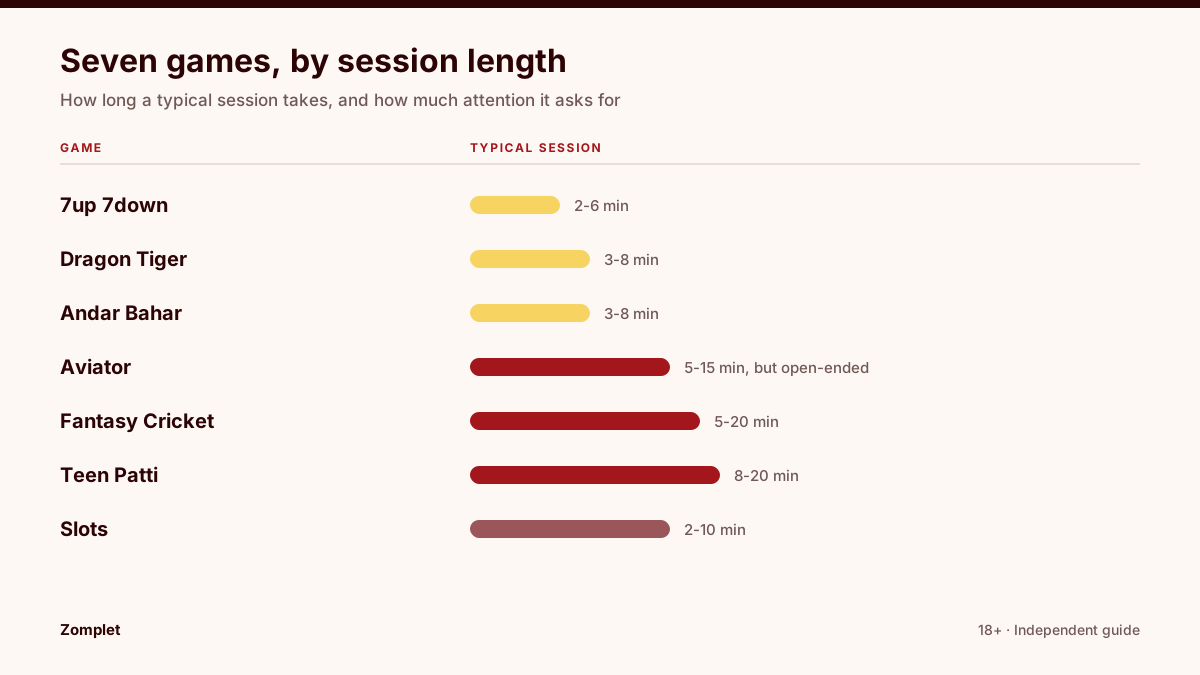
7up 7down, Andar Bahar and Dragon Tiger resolve in seconds with a single tap between you and the result. That is not a design flaw, it is the point of them. They are the easiest place on the platform to start and the easiest to leave after a short break, and treating them as something to master is a category error. The control in those titles is entirely in the stake and the clock.
Bankroll and session limits
These are the only tools that work everywhere, on every title, whether or not the game involves any skill at all. They are not a way of winning more. They are a way of making sure that a bad evening costs what you decided in advance it could cost, rather than what the mood in the room says it should. The mechanism is simple and it works because the decisions get made before the reason they need making.
What a bankroll limit is
It is a fixed amount of money set aside for play, treated as a cost of entertainment rather than as a pool to be recovered. The figure should be something you could lose in a single sitting without it affecting a plan you already have. What matters less than the amount is that it is set before you start and not adjusted during the session. A limit you raise when you are losing is not a limit, it is a decision to keep going made by the person least able to make it.
What a session limit is
It is a fixed duration or a fixed number of rounds, decided before the first one. This matters more than the money limit on the fast titles, because those resolve in seconds and nothing in the interface will tell you that forty minutes have passed. A timer you can hear does the work, and a win-loss target does it better: stop when the session is ahead, and stop when it is behind, by the same rule either way.
- Decide your bankroll limit before you open the app. Write the number down. A limit that exists only in your head is a number that can move while you are not looking at it.
- Set a time limit as well. Use an alarm rather than the clock, because checking the clock is the first thing to stop doing once the results get interesting.
- Choose a win target and a loss target in advance. When either is reached, the session is over. Both rules have to be set before, because the second one will never be set voluntarily afterwards.
- Keep the stake fixed within a session. Raising it after a loss is chasing, and it converts a small loss into a large one without changing the odds at all.
- Take a break between sessions rather than continuing. The first session after a break is a different decision from the fourth one in an hour, and you are not the same person in each.
- Record what happened. Amount, time, rounds played and outcome. A few lines per session will show you more about your own play than any theory here will.
A practical session structure
Nothing about the structure below is clever. It works because it removes the decisions that need to be made at the wrong moment. Pick one title rather than browsing a catalogue while playing, because the browsing is itself a way of extending the session without deciding to extend it.
- Before: set the bankroll figure, the time limit and the win and loss targets. All three, in writing, before opening anything.
- Start: choose the game in advance and stick to it. If you want to play a specific title, read its guide first rather than learning the rules with money on the table.
- During: keep the stake constant, ignore patterns in recent results, and do not interpret a near miss or a run as a signal. On the titles where judgement matters, trust the reasoning you made before the round.
- At the limit: stop, whatever the balance says. Ending a session ahead and ending one behind are both routine, and both should end on the same rule.
- After: note the numbers. Over time this record becomes the most useful thing you own, because it shows your actual behaviour rather than what you remember about it.
Playing on the platform at all
None of the above depends on which platform you use, but the platform itself does need checking once. A legitimate operator has a named legal entity, a real support route, a privacy policy that names actual categories of data, and withdrawal terms that state minimums, processing windows and the reasons a request can be declined. Our guide to account registration and login covers each of those checks in turn, and the install route, including why we never link to a modified build, is set out in the download and install guide.
The short version
One title here rewards real preparation, one rewards a good read of other players, one rewards timing, and the remaining four are decided by outcomes nobody can influence. That is worth knowing before you choose where to spend your attention. But the part that protects you is not that knowledge, it is a limit you set before you start and a stop rule you follow when it triggers. The full guide index has a page for every game if you want the specific rules for the one you play.
Frequently asked questions
Which WW5 game involves the most skill?
Fantasy Cricket, by a clear margin. Your XI is scored against a real match, so form, matchups, venue and role genuinely change the result, and a better-informed selection reliably outperforms a worse-informed one. Teen Patti rewards reading a table, and Aviator rewards timing a cash-out, but both are narrower than a selection you can genuinely prepare for.
Which of these games are pure chance?
7up 7down, Andar Bahar, Dragon Tiger and Slots are decided by outcomes no decision of yours can influence. That does not make them unplayable, but it does mean the only decisions worth deliberating in those titles are the stake and the session length.
What is the single most useful habit?
Deciding when you will stop before you start. A session that ends on a rule you set in advance cannot run past the point where your judgement is at its worst. Chasing a loss is the most predictable way people lose more than they planned, and it only works when nobody set a limit in advance.
Does a good strategy guarantee a profit?
No. On the titles where judgement has any effect, good strategy improves your results over many rounds rather than in any one of them. On the titles where it has none, no strategy changes the underlying maths, because the house edge is fixed and every round is independent. Anyone promising a guaranteed return from a system is describing something that does not exist.
Should I set a money limit or a time limit?
Both, and the time limit matters more on the fast titles. Rounds that resolve in seconds give you no cue that an hour has passed, and a timer you can hear solves that. The money limit protects you from the worst outcome and the time limit protects you from the thing you are more likely to do by accident.
Is it worth playing at all?
That is a personal question rather than an editorial one, and it depends on how much money you are willing to treat as a cost of entertainment. The honest framing is that these are games of chance with money attached, that the edge sits with the operator, and that the case for playing is entertainment rather than income. If the limits below are set in advance and followed, the downside is bounded. If they are not, it is not.
Where should I start if I have never played these?
With the titles that resolve fastest and ask the least, which are Andar Bahar and 7up 7down. Read the guide for one of them first, set your limits, and play a short session. The guide index lists every title, and our registration guide covers the checks worth making before you create an account anywhere.
Related guides
WW5 Fantasy Cricket: how to pick an XI that reflects form, venue and role
WW5 Fantasy Cricket explained: how to choose an XI using player form, matchups, venue and role, and why a captain matters.
WW5 Aviator: how a rising multiplier round actually works
How the WW5 Aviator round works, how long a session lasts, what the cash-out decision really involves, and the drawbacks nobody mentions.
Registering and logging in: the checks worth doing first
How to register a WW5 account properly: what to verify first, how to secure it, what to do when a login fails, and why a code is never read out.